
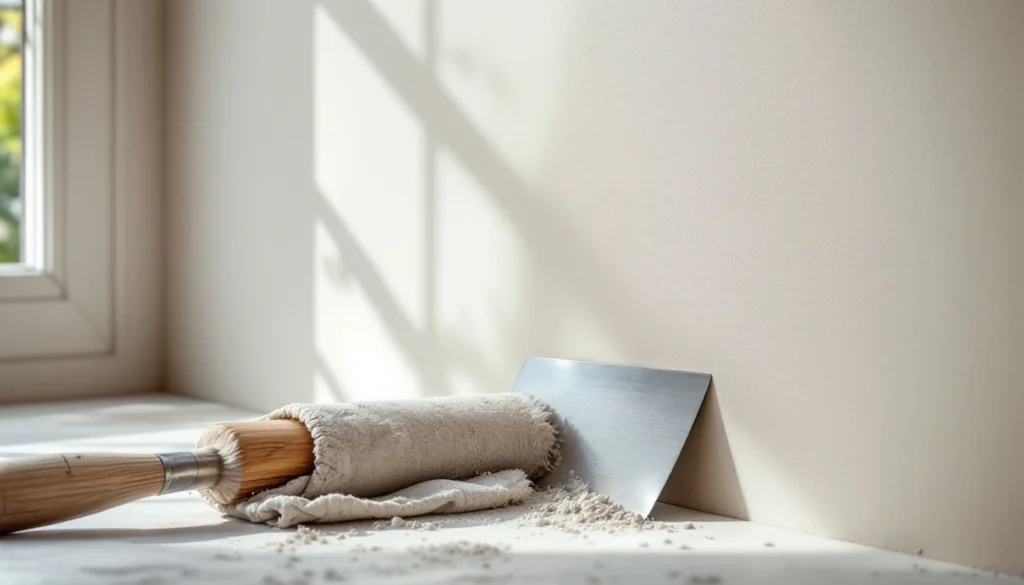
What Is Parisian Plaster?
Parisian plaster refers to a traditional French decorative plastering technique that creates smooth, subtly mottled walls with a characteristic soft sheen. Despite the name, it’s not related to Plaster of Paris (gypsum plaster) — instead, it’s a lime-based finish (plâtre à la chaux) that’s been used in French architecture for centuries.
The finish is achieved by applying multiple thin layers of lime plaster mixed with marble dust or fine aggregates, then burnishing the surface to create subtle variations in tone and texture. This creates the distinctive cloudy, organic appearance that makes each wall unique, rather than uniformly flat like standard skim plaster.
In the UK market, several manufacturers produce ready-mixed Parisian-style plaster products, though many professional decorative plasterers still prefer to mix their own using traditional lime putty and mineral pigments.
Key Characteristics of Parisian Plaster Finishes
Understanding what sets Parisian plaster apart from standard plastering helps explain why it commands premium pricing and requires specialist skills:
Visual Appearance
- Subtle texture: Smooth to the touch but with gentle variations that catch light differently throughout the day
- Natural colour depth: Achieves tonal variation without looking patchy — the “clouding” effect is intentional and sophisticated
- Soft lustre: A gentle sheen rather than glossy or matt — somewhere between eggshell and silk paint finishes
- Organic patterning: Each wall is unique, with movement that resembles watercolour washes or aged limestone
Physical Properties
| Property | Characteristic | Benefit |
|---|---|---|
| Breathability | High vapour permeability | Prevents moisture trapping in solid walls; ideal for period properties |
| Flexibility | Accommodates minor movement | Less prone to cracking than gypsum plasters |
| Hardness | Gradually carbonates over months | Becomes harder with age; develops a durable surface |
| Thickness | 2-6mm total (multiple layers) | Minimal impact on room dimensions compared to render |
| Alkalinity | pH 12-13 when fresh | Natural antimicrobial properties; inhibits mould growth |
Environmental Credentials
Parisian plaster aligns well with sustainable building practices. Lime putty requires lower firing temperatures than cement (around 900°C vs 1450°C), resulting in significantly lower embodied carbon. The material also reabsorbs CO₂ during carbonation, partially offsetting its manufacturing emissions.
Natural mineral pigments mean no VOCs (volatile organic compounds), making it suitable for chemically sensitive individuals and compliant with strict indoor air quality standards.
Parisian Plaster vs Other Decorative Finishes
When clients ask about decorative plaster options, it’s helpful to understand how Parisian plaster compares to alternatives:
| Finish Type | Base Material | Appearance | Cost per m² (installed) | Best For |
|---|---|---|---|---|
| Parisian Plaster | Lime putty + marble dust | Soft, clouded, subtle sheen | £45-85 | Period properties, minimalist modern interiors |
| Venetian Plaster | Lime putty + marble powder | High polished, marble-like | £60-120 | Feature walls, luxury bathrooms, reception areas |
| Tadelakt | Lime plaster + soap | Waterproof, smooth, waxy | £80-150 | Wet rooms, showers, spa environments |
| Standard Skim | Gypsum | Flat, uniform, matt | £12-25 | Standard residential walls, quick turnaround |
| Textured Render | Cement or acrylic | Pronounced texture | £25-55 | Commercial spaces, exterior, durability priority |
The key distinction is that Venetian plaster is highly polished to achieve a glass-like finish, whilst Parisian plaster maintains a softer, less formal appearance. Both use lime, but the application technique and final burnishing differ significantly.
Application Process: How Parisian Plaster Is Installed
Applying Parisian plaster requires specialist skills that go beyond standard skim coating. Here’s the professional process:
Surface Preparation
Proper preparation is critical for longevity and appearance:
- Substrate assessment: Best applied to solid backgrounds (traditional lime plaster, cement render, dense concrete blocks)
- Plasterboard considerations: Can be applied to plasterboard if first sealed with specific lime-compatible primers (standard PVA won’t work)
- Surface levelling: Wall must be flat and true — any undulations will be accentuated by the finish
- Priming: Apply breathable primer suitable for lime products (often a diluted lime wash or specialist acrylic)
Mixing and Preparation
Professional-grade Parisian plaster requires careful mixing:
- Ready-mixed products: Brands like Bauwerk Lime Paint, Vasari Lime Plaster, or Farrow & Ball Lime Wash Plaster come pre-mixed
- Traditional approach: Mix aged lime putty (minimum 3 months maturation) with marble dust at approximately 3:1 ratio
- Tinting: Add natural mineral pigments (earth oxides) during mixing — aim for 5-8% pigment by volume for pastels, up to 15% for deeper tones
- Consistency: Similar to thick double cream — should hold peaks but spread smoothly
Layer-by-Layer Application
| Layer | Thickness | Purpose | Drying Time |
|---|---|---|---|
| First Coat | 1-2mm | Base layer that keys to substrate | 6-12 hours (depends on humidity) |
| Second Coat | 1-2mm | Builds coverage and begins texture development | 12-24 hours |
| Final Coat | 1mm | Creates characteristic clouding and finish quality | 24-48 hours before burnishing |
| Optional Fourth | 0.5mm | For premium finishes with extra depth | 24 hours |
Tools and Technique
Specialist tools create the authentic Parisian plaster aesthetic:
- Japanese steel trowels: Flexible stainless steel blades (280mm or 300mm) for smooth application
- Plastic or rubber spatulas: For creating texture and movement in the wet plaster
- Natural sponges: Dampen and blend edges between sections
- Burnishing tools: Polished steel or smooth plastic for final sheen development
The application isn’t about perfect flatness — plasterers deliberately vary pressure and trowel angle to create the organic variations. Work in random, overlapping strokes (figure-eight or circular patterns) rather than straight lines.
Burnishing and Finishing
The final burnishing happens when the plaster is firm but not fully carbonated:
- Timing: Typically 24-72 hours after final coat, depending on room temperature and humidity
- Method: Apply gentle pressure with a polished steel trowel or plastic spatula in circular motions
- Effect: Compresses the surface, closes pores slightly, and develops the characteristic soft lustre
- Waxing (optional): Some applicators finish with a thin coat of natural beeswax for added sheen and water resistance
Where to Use Parisian Plaster: Best Applications
Parisian plaster suits specific environments and design aesthetics. Here’s where it performs best:
Ideal Locations
- Living rooms and bedrooms: Creates calming, sophisticated ambiance; excellent backdrop for minimalist furniture
- Period properties: Sympathetic finish for Georgian, Victorian, Edwardian homes with solid brick walls
- Feature walls: Behind beds, fireplace alcoves, dining areas where natural light varies throughout day
- Entrance halls: Makes a statement whilst maintaining understated elegance
- Home offices and libraries: Provides non-distracting background with acoustic benefits
- Boutique retail and hospitality: Increasingly popular in restaurants, hotels, galleries for premium aesthetic
Locations to Avoid
Whilst lime plaster is breathable and naturally antimicrobial, certain environments aren’t suitable:
- High-splash zones: Standard Parisian plaster isn’t waterproof — use tadelakt or tiles around sinks/baths instead
- Kitchens behind hobs: Heat and grease can mark and discolour the finish over time
- Children’s play areas: More susceptible to marking than vinyl paint, though can be repaired
- High-traffic commercial corridors: Better suited to lower-impact environments
Design Styles That Work
Parisian plaster complements specific interior design approaches:
| Design Style | Why Parisian Plaster Works | Typical Colour Choices |
|---|---|---|
| Modern Minimalist | Clean lines, subtle texture adds warmth without clutter | Whites, pale greys, soft taupe |
| Scandinavian | Natural materials, breathable finishes, connection to nature | Off-whites, chalk whites, very pale blush |
| French Provincial | Authentic historical technique, rustic elegance | Warm whites, ochres, soft terracottas |
| Wabi-Sabi | Celebrates imperfection, organic variation, natural ageing | Natural lime white, soft earth tones |
| Mediterranean | Traditional lime finishes, connection to southern European vernacular | Warm whites, pale ochres, dusty pinks |
Costs and Pricing: What to Expect in 2026
Parisian plaster represents a significant investment compared to standard plastering. Understanding the cost breakdown helps with budgeting:
Professional Installation Costs
| Specification | Cost per m² | Typical Room (20m²) | Notes |
|---|---|---|---|
| Basic Parisian finish (2 coats) | £45-65 | £900-1,300 | Standard colours, simple room shape |
| Premium finish (3-4 coats) | £60-85 | £1,200-1,700 | Complex colours, additional depth |
| Colour-matched custom tints | +£8-15 | +£160-300 | Matching specific paint colours or samples |
| Preparation (wall repair) | £15-35 | £300-700 | If existing walls need levelling/repair |
| Waxed finish | +£10-18 | +£200-360 | Enhanced sheen and durability |
These prices reflect typical rates in Kent and the South East in 2026. Prices in London may be 15-25% higher, whilst Northern regions might see 10-15% lower rates.
Compare this to standard skim plastering, which typically costs £12-25 per m², and you’ll see why Parisian plaster is positioned as a premium decorative finish.
DIY Material Costs
For experienced DIYers willing to attempt the technique:
- Ready-mixed Parisian-style plaster: £45-75 for 5kg (covers approximately 8-12m² for two coats)
- Traditional lime putty: £18-28 per 25kg tub from specialist suppliers like Mike Wye & Associates
- Marble dust/aggregate: £12-18 per 20kg bag
- Natural pigments: £8-15 per 100g (a little goes a long way)
- Specialist trowels: £25-45 each (you’ll need 2-3 different sizes)
- Primers and sealers: £35-50 per 5L tin
Maintenance and Longevity
One of Parisian plaster’s advantages is its durability and ease of maintenance when properly applied:
Routine Care
- Cleaning: Wipe with slightly damp microfibre cloth — no harsh chemicals needed
- Dusting: Standard soft brush or vacuum with brush attachment
- Stain removal: Most marks can be gently buffed with a white eraser or fine-grade sandpaper (P400+)
- Frequency: Minimal maintenance required — typically just occasional dusting
Repairs and Touch-Ups
Unlike paint, lime plaster can be seamlessly repaired without visible patches:
- Small damage: Apply fresh plaster to the affected area, feather edges, and burnish to match
- The lime continues carbonating, so repairs integrate chemically with the original finish
- Touch-ups become virtually invisible after a few weeks of curing
Expected Lifespan
Properly applied Parisian plaster should last 20-30+ years with minimal intervention. The finish actually improves with age as carbonation continues, gradually increasing hardness and durability. Many French buildings feature lime plaster walls that are centuries old.
According to guidance from the Society for the Protection of Ancient Buildings, lime plasters are inherently more durable in historic buildings than modern gypsum alternatives due to their flexibility and breathability.
Common Mistakes and How to Avoid Them
Even experienced plasterers can encounter issues when transitioning to decorative lime finishes. Here’s what to watch for:
Application Errors
- Working too fast: Rushing between coats prevents proper keying and can cause delamination
- Over-trowelling: Excessive working creates burn marks (dark patches) and damages the finish
- Inconsistent thickness: Varying coat thickness produces uneven colour — maintain 1-2mm per layer
- Wrong ambient conditions: Applying in temperatures below 5°C or above 30°C affects curing
- Ignoring humidity: Very dry conditions (below 40% RH) cause too-rapid drying and potential cracking
Material Preparation Issues
- Using fresh lime putty: Lime should mature minimum 3 months, ideally 6-12 months for best workability
- Incorrect pigment dispersion: Always pre-disperse pigments in water before adding to plaster to avoid streaking
- Contaminated tools: Any cement residue on tools can cause staining — keep lime tools separate
Substrate Problems
- Applying over damp walls: Check moisture levels with a meter — should be below 6% before application
- Incompatible backgrounds: Painted plasterboard sealed with vinyl paint won’t accept lime plaster properly
- Inadequate preparation: Any loose material or poorly keyed surfaces will telegraph through the finish
Regulations and Standards
While decorative plastering doesn’t face the same regulatory oversight as structural work, certain standards apply:
Building Regulations Compliance
Parisian plaster doesn’t typically trigger Building Regulations for existing residential interiors. However, if you’re applying it as part of larger works:
- Part L (Conservation of fuel and power): Lime plaster on external walls slightly reduces thermal performance compared to modern insulated plasterboard systems
- Part C (Resistance to moisture): The breathability benefits solid-wall properties but shouldn’t be used as a damp-proof barrier
- Fire resistance: Lime plaster is inherently fire-resistant (Class A1 non-combustible under BS EN 13501-1)
Heritage and Conservation
For listed buildings or conservation areas, lime-based finishes are often preferred or required by planning authorities. The Historic England guidance on lime emphasises using breathable, traditional materials that are compatible with historic fabric.
Frequently Asked Questions
Can Parisian plaster be applied over standard plasterboard?
Yes, but with important caveats. Standard plasterboard must first be sealed with a lime-compatible primer — never use PVA or vinyl-based sealers, which create an impermeable barrier. Many professionals prefer to apply a base coat of standard multi-finish skim first, then seal appropriately before applying the decorative lime layers. The plasterboard substrate must be rigid and well-fixed, as any movement can crack the decorative finish.
How long does Parisian plaster take to fully cure?
Whilst Parisian plaster feels dry to touch within 24-48 hours, the carbonation process (where lime reacts with atmospheric CO₂ to form calcium carbonate) continues for weeks to months. Surface hardness develops over the first 2-4 weeks, but the plaster continues to strengthen and harden for up to a year. This is normal and beneficial — the finish becomes more durable over time. You can paint or decorate over it after 4-6 weeks, though many people prefer to leave it as the finished surface.
Is Parisian plaster suitable for bathrooms?
Parisian plaster can be used in bathrooms, but not in direct wet areas. It’s ideal for bathroom walls away from showers and baths, where it provides breathability that helps regulate humidity. However, for shower enclosures, bath surrounds, or areas that receive direct water spray, consider waterproof alternatives like tadelakt (a Moroccan lime plaster sealed with olive oil soap) or traditional tiles. Some specialists apply microwax sealers to Parisian plaster in bathrooms for added moisture resistance, though this reduces breathability.
Can you paint over Parisian plaster if you change your mind?
Yes, Parisian plaster can be painted, though it somewhat defeats the purpose of the decorative finish. If you do paint it, use breathable paints only — clay paints, mineral paints, or lime wash are ideal choices. Standard vinyl emulsions will seal the surface and prevent the lime from breathing, potentially causing moisture problems. Many people choose subtle limewash tints over Parisian plaster to change colour whilst maintaining the textured appearance and breathability. Bear in mind that quality Parisian plaster installations represent a significant investment, so consider colour choices carefully before application.
What’s the difference between Parisian plaster and Venetian plaster?
Both are lime-based decorative finishes, but they create distinctly different aesthetics. Venetian plaster is highly polished (often with multiple burnishing sessions) to create a glossy, marble-like finish with visible colour variations and depth. Parisian plaster maintains a softer, more subtle appearance with gentle clouding and a semi-matt to satin sheen. Venetian plaster typically requires more layers (4-7 coats) and intensive burnishing, whilst Parisian plaster uses fewer coats (2-3) with gentler finishing. In terms of formality, Venetian plaster suits grand, classical spaces, whilst Parisian plaster fits both elegant traditional and contemporary minimalist interiors.
How does Parisian plaster perform in period properties with damp issues?
Parisian plaster actually performs better than modern gypsum plaster in period properties precisely because of its breathability. Solid brick or stone walls in older buildings naturally allow moisture to move through them — this is how they were designed to function. Modern impermeable finishes (vinyl paints, gypsum plaster, cement renders) trap moisture, leading to damp problems. Lime-based Parisian plaster allows walls to “breathe,” letting moisture evaporate naturally. However, it’s not a solution for serious damp problems — you must still address any underlying issues (rising damp, failed pointing, roof leaks) before applying any decorative finish. The lime plaster simply won’t trap moisture the way modern materials do, making it the traditional and appropriate choice for historic buildings.